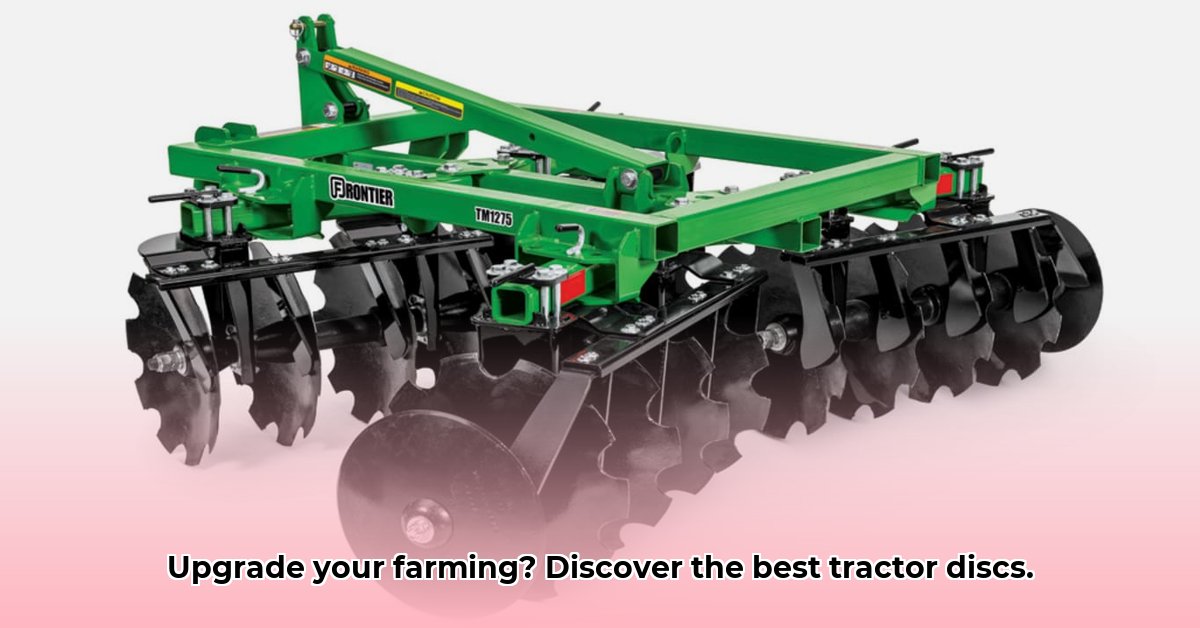
Discs for Tractors: Your Guide to Efficient Tillage
Finding the right tractor disc is crucial for maximizing farming efficiency. This guide covers disc types, market analysis, buying advice, maintenance, and future trends in sustainable tillage. For more options, check out these used tractor discs.
Understanding Tractor Discs: Types and Benefits
Tractor discs are essential tools for soil preparation before planting. They break up soil clods, incorporate crop residue, and improve soil structure. However, various types exist, each suited for different tasks and soil conditions:
Offset Discs: These angled discs pull soil to one side, ideal for contour plowing on slopes, minimizing erosion. Think of it as gently guiding soil to the correct places.
Tandem Discs: Featuring two sets of discs working together, these provide more aggressive tillage, perfect for breaking up heavy or compacted soil. They're like a heavy-duty team tackling tough jobs.
Single Discs: Simpler and often less expensive, single discs are suitable for lighter tasks such as smoothing the soil or finishing touches. They're the versatile handyman of the disc world.
[Insert images of offset, tandem, and single discs here]
The benefits of using tractor discs extend beyond simple soil preparation. They contribute to sustainable farming by reducing soil compaction (leading to better water infiltration and root growth) and improving soil aeration. Do you want to minimize your environmental impact while maximizing yields? A well-chosen disc can help you achieve both.
Navigating the Tractor Disc Market: New vs. Used
The market for tractor discs shows high demand, but obtaining precise market data is difficult. A significant secondary market exists for used equipment. This abundance of used discs raises questions: Does it reflect affordability concerns among farmers? Is there hesitation to adopt newer technologies? Or are older, well-maintained discs surprisingly durable and long-lasting? These factors significantly influence buying decisions. The answer, likely, is a combination of all three. Careful consideration is required before committing to a purchase.
Buying & Using Tractor Discs: A Practical Guide
Choosing the right disc involves a multi-step process. Let’s break down how to select the best disc for your needs:
Step 1: Assess Your Needs: Before you begin your search, evaluate the following:
Budget: Determine a realistic budget, remembering to factor in maintenance costs. How much can you reasonably invest?
Soil Type: Different soil types require different tillage approaches. Clay soils demand a robust disc whereas lighter soils need gentler treatment. What’s the composition of your fields?
Farm Size: Larger farms often benefit from larger, more powerful discs. Scale matters in optimizing both time and resources. How many acres do you cultivate?
Tractor Power: Ensure the disc’s size is compatible with your tractor's horsepower capabilities. Matching horsepower is vital for effective and safe operation.
Step 2: Choosing the Right Disc: Use this decision-tree as a starting point:
                      Start
                       |
                       V
Heavy Soil/Large Field? Yes --> Tandem Disc
                       |
                       No --> Consider Single/Offset Disc
                       |
                       V
Check Budget & Condition
                       |
                       V
Purchase
Step 3: Maintenance for Longevity: Regular maintenance significantly extends the lifespan of your disc:
Regular Lubrication: Keep moving parts well-lubricated to prevent wear and tear. This is a simple but effective preventative measure.
Blade and Bearing Checks: Regularly inspect for damage and replace worn parts promptly. Ignoring minor issues can lead to costly repairs later.
Proper Storage: Protect your disc from the elements during periods of non-use. Appropriate storage prevents premature deterioration.
Step 4: Efficient Tillage Practices: Optimize disc usage to minimize soil disturbance:
Avoid Over-Tillage: Excessive tillage compacts the soil, reducing yields. Less is often more in this case.
Adjust Depth and Speed: Adjust these factors based on soil conditions for optimal results. Adaptability is key to efficient tillage.
Step 5: Evaluating Used Discs: Carefully inspect used discs before purchasing:
Blade Inspection: Check for wear, chipping, or bending.
Frame Assessment: Look for cracks, bends, or structural damage in the disc's frame. A sound structure is paramount.
Bearing Test: Ensure bearings spin freely without roughness or play. This indicates the disc's overall health.
Price Negotiation: Negotiate a fair price reflecting the disc's condition.
Future Trends in Sustainable Tillage
The future of tillage involves precision agriculture technologies, such as GPS-guided equipment and smart sensors, that optimize tillage depth and intensity based on field-specific needs. These advancements aim for sustainable, high-yield agriculture, minimizing environmental impact while maximizing productivity. What does the future hold? More efficient and environmentally friendly practices.
Resources and Further Reading
Natural Agro Express